Sunday, 1 May 2016

One More Way To Create a Healthier Plan!


A big step this Spring in setting you up for success to a healthier you is to remove what I call the "nutrient robbing foods" or other foods or drinks from you daily nutrition plan, that don't align with your health goals.  Doing this is quite simple when you start from the source of most of these foods:  your own cupboards.

OUT OF SIGHT, OUT OF MIND - MOSTLY!
Purging the Pantry is not only a good idea twice a year to check on expiry dates of products, but is the first step in solidifying that decision to eat healthier when tempting snacks, overly processed foods and drinks are not in easy reach.  This rule applies to the fridge and freezer as well.  Set aside 30 minutes on a Sunday afternoon (Monday morning fresh starts seem to work well for most people.  Grab a box or basket and open up every food cupboard in your kitchen.  Empty each shelf and as you place it back, you'll first check the expiry date and second, is it a food that fits with your goal?  A box of pasta doesn't go back if you are trying to cut back on your intake of starchy carbohydrates.  That box of chips or bag of skittles don't go back either if you're keen to stop the snacky junk food.
Now the fridge and freezer!  Bottled sauces and salad dressings are a toss if you want to make more things from scratch or use simpler things like fresh or dried herbs for cooking and oil and lemon juice based dressings.

BE RUTHLESS!
Trust me, if you talk yourself into keeping something that you know you want to avoid, you are setting yourself up for a weak, sabotaging moment.  If you have to go out to buy it, you'll have time to think about that action.  It also doesn't mean you will never have that item again, it's just right now, you need positive reinforcement (some positive words on the fridge are great!) and zero temptations when committing to a new habit.

WHAT TO DO WITH THE FOOD???
A good question when it seems a waste to throw food out, however if it's well past the expiry date, it should most likely go in the trash.  If not, unopened things can go to the local food bank and other things can be passed to family or friends.  However, encouraging your family and friends to do the same thing will do a long way to help you with your goal, so maybe making the garbage toss is the best thing!  Vow to put your future food spending to better use!

GETTING PREPARED FOR THE NEW PLAN
O.K. The cupboards, fridge and freezer are cleared, and maybe a little empty, so now head to the local market or grocery store, with a list in hand, of what fresh foods and minimally processed canned  or packaged (and there are some good ones), you ARE going to purchase that do fit with your goals.

To help give you a start with that, watch my webinar on how to incorporate more green foods into your diet and why they are a must have every day.

It's Easy Being Green!

Thursday, 14 April 2016

Detox Your Living Space

It’s Spring and our thoughts turn to Spring Cleaning the house, garage and doing yard clean up. It’s a great time to Spring Clean your body with a full body cleanse, but go one step further and when you spring clean your house, start detoxifying it as well.
1. Choose furniture and carpet materials that are made of natural fibers. When this is not possible, use ferns and spider plants to absorb off-gassing fumes.
2. Reduce Electro Magnetic pollution by unplugging appliances when not in use, use filter screens on computers if needed, up-grade equipment if possible, do not use or severely reduce the use of cell phones, cordless phone and microwaves. Do not place alarm clocks near your head and try not to have the head of your bed positioned next to an electrical outlet. Do not live near overhead electrical wires if possible. Use hot water bottles and extra blankets instead of heating pads and electric blankets.
3. Drink filtered, remineralized water. Install carbon filters on all shower heads or if possible a filter at the entry point of the water into your home.
4. Allow as much natural light into your space as possible. Use full-spectrum light bulbs, especially in lights that are used for reading.
5. As you use up chemical cleaners in your home, begin replacing them with more environmentally friendly types.
6. Start replacing your cosmetics and body care products with ones that do not contain toxic ingredients.
Lavender is calming
7. Purchase a beginners guide to natural medicine and begin using natural products to treat common health issues, such as headaches, nausea, diarrhea, digestive complaints, etc.
8. Use stainless steel utensils and kitchenware; avoid using plastic wrap and aluminum foil. Get rid of any aluminum pots.
9. Start thinking about the things that you bring home that are overly packaged and purchase things in bulk.
10. Compost your food scraps and use the material in your garden.
11. Eat organic food whenever possible and avoid the use of lawn and garden pesticides.
12. Certain house plants, like spider plants, are great for filtering the air.  Treat houseplants with natural insecticide soaps.

Sunday, 1 March 2015

La Bonne Cuisine de la France

I arrived in Paris, France on February 14th to spend the next three weeks with my daughter Megan who has been living there since August 2013.  My husband would be joining us on February 20th.  Ahhhhh Paris!  Ahhhhh La France!  The memories come flooding back: traveling in Europe at the age of 18, going to school in Besançon for a year at the age of 22/23 (30 years ago actually), coming to Paris dozens of weekends when I worked as a flight attendant (yes it's true),traveling when Megan was 2 and a half and again with all our 3 kids 10 years ago!  I will always loving coming here - maybe I've spent past lives here (I'm sure I have) and it's in my blood!
I love the architecture, the geography but most of all I love the food!!  Ahhhhh la nouriture!  It's truly an art here and you I have still seen evidence of the pride people take in the creation of amazing food.  The presentation is stellar and although the north american influence of fast food places has made it's mark, they do not - thankfully - over shadow all the wonderful patiseries, boulangeries, charcuteries and restaurants - both "fin and bon marché".
So as a foody but also confessed granola head and someone who usually eats little dairy and little to no gluten - how to survive in France for three whole weeks?????  Well, here's a word to the wise traveler who can be a little over food obsessed as I have been - and I mean obsessing over "what will I eat, that I can have?"  Ready??  When in Rome..........with some mindfulness attached.
Yes, that's my rule of thumb now when it comes to traveling.  Eat, enjoy, and find a balance.  Food in an integral part of every culture and social matrix.  Food is meant to be experienced and enjoyed as part of the whole experience of traveling to another part of the country or world!  Now when it comes to Europe, the food is not that different from North America in it's foundation. Yet as a foody and a health conscious one at that, I keep my eyes open for key things and what I have observed on this trip are the following:
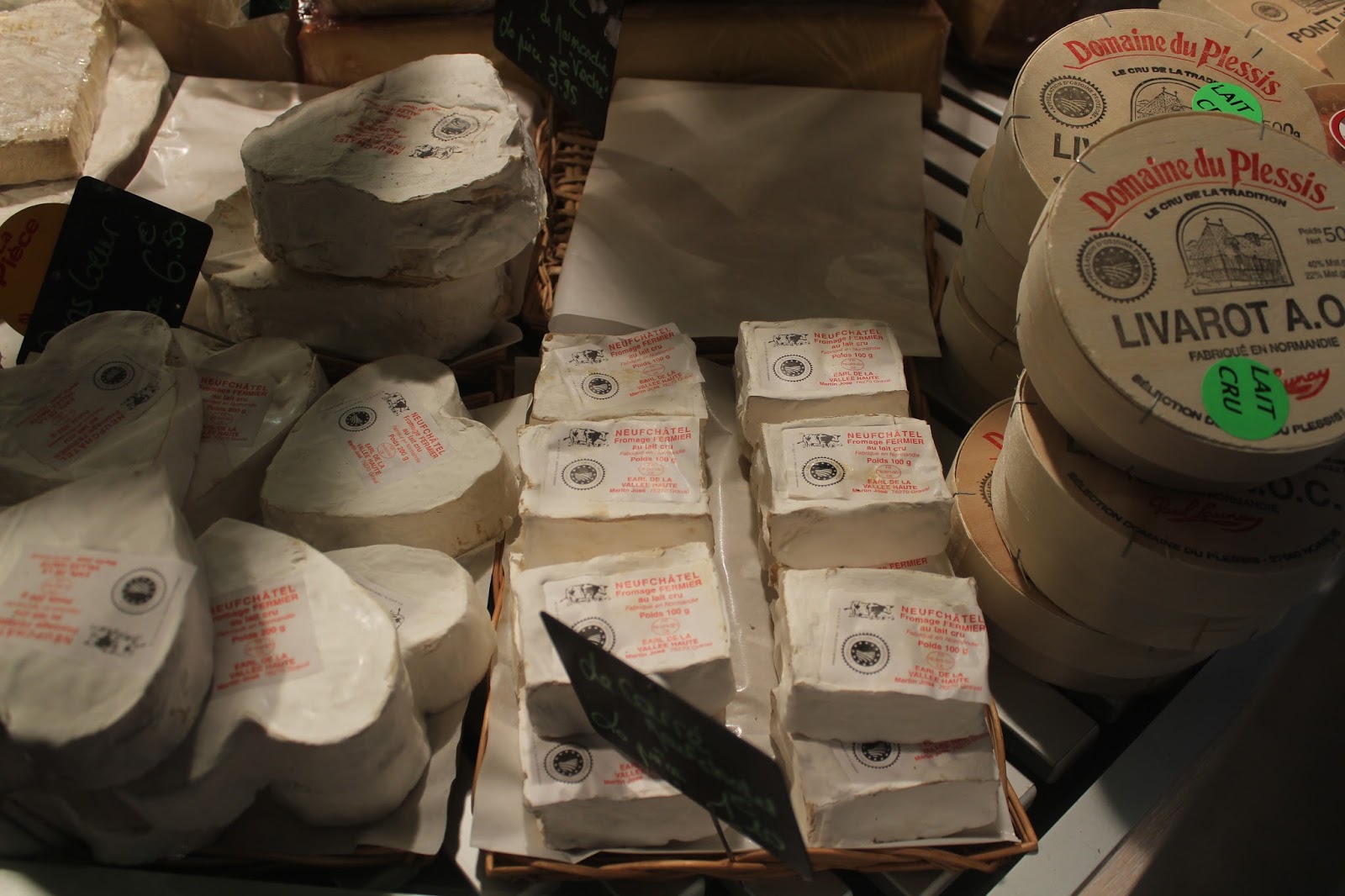
The local markets, usually happening one day per week, in just about every small town like Lyons la Forêt (a very small village in Normandy that we visited) still exist in full force and these dedicated vendors are committed to providing people fresh, local food to the local citoyens and travellers alike.  The woman who sold us our cheese in Lyons la Forêt, lit up when we asked for a recommendation and went on to describe the nature and texture of the local cheese we were buying.  Small local farmers markets are increasing every year in North America though.  The slow food approach is making it's mark, which is a breath of fresh air. However, the small market scene in North America is different than what you still find in Europe, and other continents, and have been able to find for centuries.  
What is evident about the food culture here is the emphasis on fresh and available and minimally processed.  To find cheeses made "du lait cru" (raw milk) is more common than not, and yet our government makes it almost impossible to enjoy cheeses or other dairy products in this way.  Typically lactose intolerant, I find my body does not reject the raw cheese as it would other cheeses at home, therefore my reasoning for the "when in Rome" approach.  Flour products here are not made to last more than one day, two at most, therefore no preservatives.  Artisanal bakeries in North America use a slow fermentation processes, which is the traditional way to make breads and pastries, to make them more digestible.  The difference is finding these items very well priced in France, where one would pay more of a premium in North America (however worth every penny!)   I spoke with a woman in a beautiful family owned health food store in Dijon about the gluten issue and if they were finding the same issues in France.  She said that there was quite an awareness around it and as a result, many people have been reducing or cutting out their consumption of bread or choosing gluten free options.   So the trends are ripling world wide.  
While packaged, non-nutritious foods can be found in the super-marché but not in the quantities that would be found on grocery store shelves at home. Of course I scoured the shelves for things that are common for me to buy at home: almond milk, coconut water, super foods, gluten free items and all things organic.  The Agriculture Biologique label in France can be easily found on many products - most importantly for me was wine! - and in most shops or stores.  
Traditions still live strong in France and along with myriad of 12 century to present day structures, I will never tire of the experiences of the people, food and places of this land.